What a Spatial Technologist Actually Builds
Radar sensors, linear actuators, Unreal pipelines, and physical architecture
Spatial Technologist & Scenographer · MAS ETH DFAB Alumnus
Most job titles with the word spatial end up trapped behind VR headsets or web mockups.
Real spatial technology happens out in the room. It deals with 230-volt mains power, concrete anchor points, millimeter-wave radar sensors, and steel linkages. It turns physical environments into responsive systems.
When someone walks into a room, the space should recognize their presence without forcing them to install an app or strap plastic across their eyes.
| Metric | Specification | Real-World Deployment | | :--- | :--- | :--- | | Tracking Rate | 60 Hz wireless UDP broadcast | Nike House of Innovation Paris (IMU sneaker rotation) | | Proximity Gate | 1.5 meter radar trigger radius | Nike Air Max DN8 breathing sculpture plinths | | Canvases | 16K LED 360-degree real time | Outernet London (Unreal Engine 5 + Ventuz) | | Audio Stems | 5.1 surround spatial sound | L-Acoustics multi-channel procedural synthesis |
Hardware on the floor
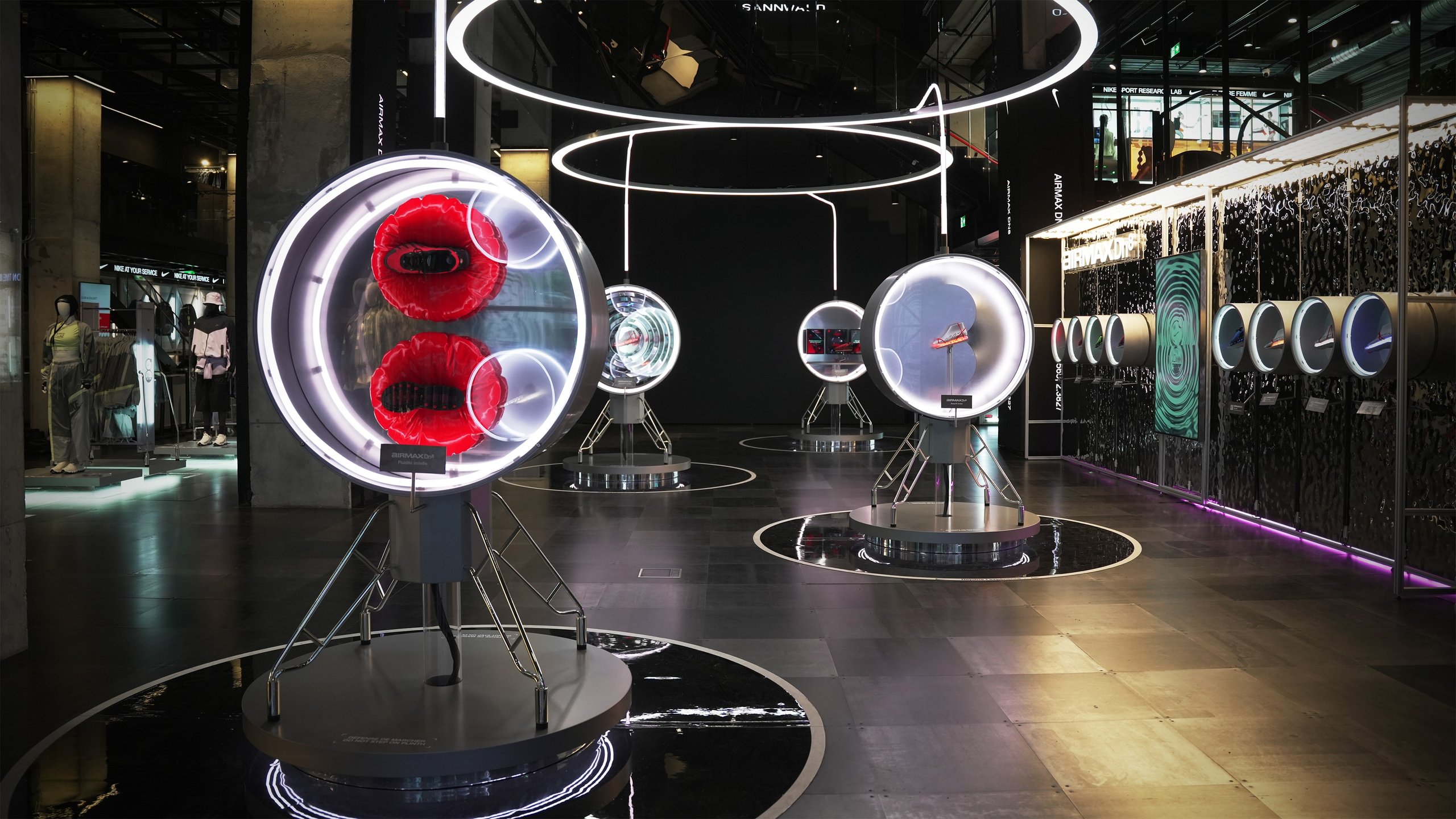
At the Nike House of Innovation in Paris for the Air Max DN8 launch, we needed visitors to feel shoe cushioning before touching a product.
We built four kinetic stations. One was a breathing sculpture shaped like an eight. Two shoes rested on red velvet mounts driven by industrial linear actuators. Millimeter-wave radar sensors hidden inside the plinth tracked human approach distance. When someone stepped within 1.5 meters, the actuators shifted cycle speed to match human breathing rhythm.
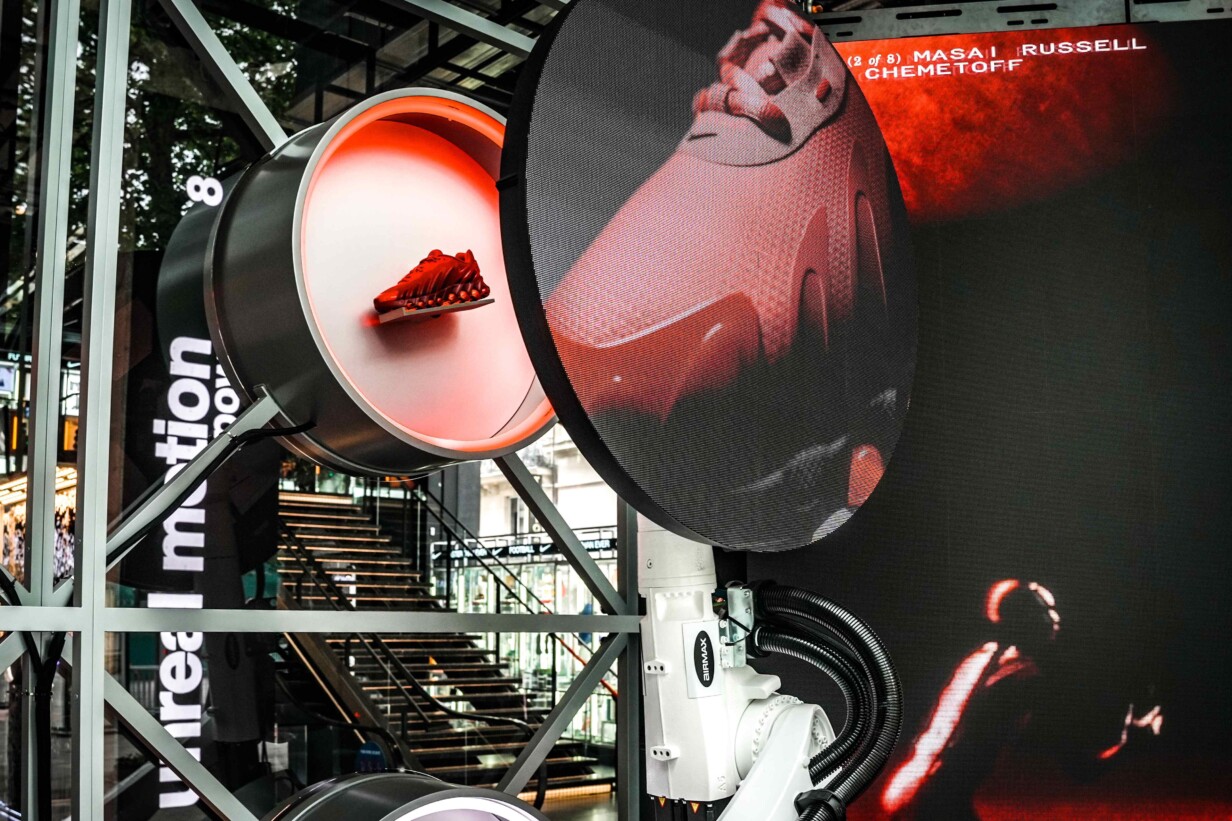
Another station used miniature 6-axis IMU gyroscopes mounted directly inside a physical sneaker. Visitors picked up the shoe and turned it by hand. As they rotated the leather and foam, the sensor broadcast Euler angles over wireless UDP packets at 60 Hz. The rotation mirrored onto three synchronized 4K displays running real-time 3D geometry with zero perceptible lag. DMX spotlights overhead tracked the shoe angle, shifting color temperature in real time.
That is spatial technology. It connects physics, mechanics, and code into one continuous feedback loop.
The technical role matrix
How does a spatial technologist differ from creative technologists or traditional architects? The boundaries are distinct:
| Discipline Dimension | Traditional Architect | Creative Technologist | Spatial Technologist | | :--- | :--- | :--- | :--- | | Primary Canvas | Concrete, glass, structural steel | Web browsers, mobile screens, projection | Physical room wired as a live runtime | | Core Input Layer | Static building code, foot traffic studies | Mouse, touchscreens, optical cameras | Radar point clouds, LiDAR, IMU gyros | | Compute Engines | Revit, AutoCAD, Rhino 3D | WebGL, Three.js, React, openFrameworks | Unreal Engine 5, Ventuz, TouchDesigner | | Physical Actuation | Fixed doors, manual window blinds | Minimal (screen and audio only) | Stepper motors, linear servos, DMX arrays | | Latency Budget | Years (design and construction cycles) | 100 milliseconds (web interaction) | Under 30 milliseconds (room response) |
The real-time pipeline
Standard architecture is static. You pour concrete, paint plaster, turn on ceiling lights, and walk away.
Spatial tech treats rooms as live software runtimes. Here is the operational stack I deploy:
- Sensory input: 24 GHz millimeter-wave radar, LiDAR scanners, Displax multi-touch foil arrays, and industrial camera feeds.
- Microcontrollers & bridges: ESP32 chips running custom C++ firmware, routing sensor values over Open Sound Control (OSC) and Art-Net.
- Compute cores: High-performance PC nodes running Unreal Engine 5, Ventuz, or TouchDesigner.
- Physical output: Stepper motors, linear servos, DMX fixtures, and L-Acoustics spatial audio channels.
"Standard architecture is static. You pour concrete, paint plaster, turn on ceiling lights, and walk away. Spatial tech treats rooms as live software runtimes."
At Outernet London, we scaled this into an interactive audio-visual multiplayer orchestra across 16K LED surfaces. Guests stepped onto the plaza, connected their mobile devices to local network stems, and triggered generative avatars across a four-story canvas with 5.1 surround spatial audio.

Bridging architectural concept and site reality
Architects often draw wild futuristic sketches during pitch competitions. Then engineering contractors arrive, cross off half the ideas, and blame budget constraints.
A spatial technologist prevents that breakdown. Because I hold a Master of Advanced Studies from ETH Zurich in digital fabrication and an architecture degree, I calculate motor torque curves and structural clearances before cutting aluminum.
If you understand mechanical tolerances, robotic toolpaths, and real-time network latency, you can build spaces that feel genuinely alive.
Frequently Asked Questions
What is the difference between a spatial technologist and a creative technologist?↓
A creative technologist often builds screen-first interactive media, creative code, or web experiences. A spatial technologist starts with physical architectural space, structural tolerances, embedded sensors, motor mechanics, and building systems, then wires real-time graphics directly into the room.
Which hardware tools does a spatial technologist use?↓
Core hardware includes millimeter-wave radar presence sensors, 6-axis IMU gyroscopes, industrial linear actuators, stepper motor drivers, DMX lighting controllers, and ESP32 microcontrollers communicating over OSC, UDP, and Art-Net.
Which software engines drive real-time spatial installations?↓
Unreal Engine 5, TouchDesigner, Ventuz, and Unity. Computational geometry runs inside Rhino and Grasshopper with Python and C# toolpath scripts.
Referenced Case Studies & Installations
Nike: House of Innovation Paris
Air Max DN8 Launch: Kinetic Retail Experience
Outernet: The Now Building London
Enchanted Forest: Melody of the Spirits
Continental HQ, Hannover
STREAM: The Empowering Source